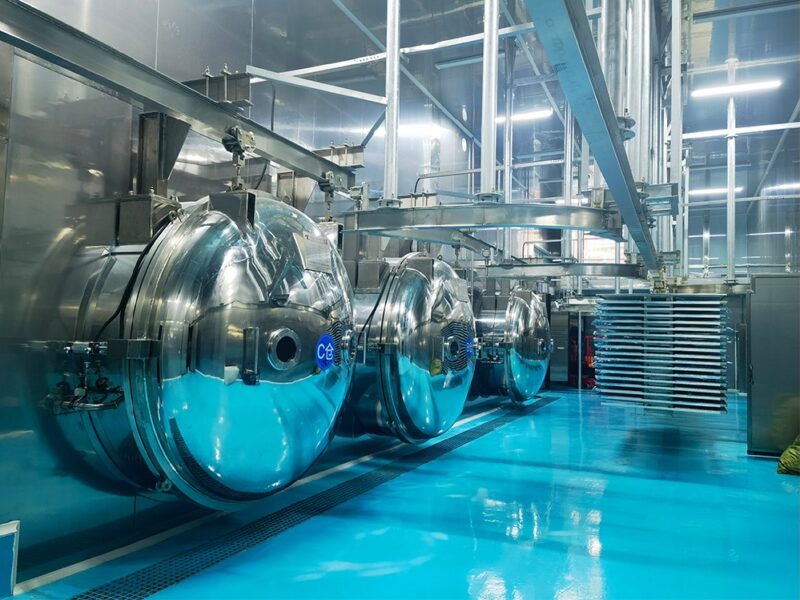
Freeze-drying (also known as lyophilization) is one of the most advanced food preservation technologies in the modern food industry. It is widely used to produce high-quality freeze-dried fruits, vegetables, and other food ingredients that retain original flavor, nutritional value, and structure — far superior to traditional drying methods.
1. What Is the Freeze-Drying Process?
Freeze-drying involves four main stages:
1) Pre-Processing
Fresh raw materials are thoroughly cleaned and prepared by peeling, slicing, or cutting as appropriate for the product.
2) Quick Freezing
The product is rapidly brought below its freezing point — typically between -30°C to -50°C — to form uniform fine ice crystals. This reduces structural damage and preserves cell integrity.
3) Vacuum Drying (Sublimation)
Under a strong vacuum (usually 0.01–0.1 mbar), ice sublimates — that is, it goes directly from solid to vapor without becoming liquid. This unique characteristic of freeze-drying preserves the food’s original shape, structure, and soluble nutrients.
4) Post-Treatment and Packaging
The dried product is cooled, inspected, and then packed in airtight materials that protect against moisture and microbes, ensuring long-term preservation.
2. What Makes Freeze-Dried Food Special?
✅ Superior Nutrient Preservation
Because freeze-drying occurs at low temperature and low pressure, heat-sensitive nutrients — such as vitamins, minerals, and natural antioxidants — are preserved far better than in conventional hot-air drying.
✅ Minimal Weight, Easy to Store
Freeze-drying removes nearly all water, which significantly reduces weight and makes storage and transportation much easier and more cost-efficient.
✅ Excellent Rehydration
Products can rapidly rehydrate back close to their original texture and flavor because freeze-drying leaves a porous structure that readily absorbs water.
✅ Long Shelf Life
Due to extremely low moisture content, microbial growth is limited, giving freeze-dried foods a shelf life measured in years under proper storage conditions.
⚠️ Higher Production Cost
High-quality freeze-drying requires advanced equipment and energy input, which leads to higher production costs compared to traditional drying. However, the value gained in quality and nutrition often outweighs this cost.
3. Applications of Freeze-Dry Technology
🔹 Food & Beverages
Freeze-dried fruits and powders are used in:
- Breakfast cereals and granola
- Bakery and confectionery
- Beverages and smoothies
- Dairy and frozen desserts
- Snack foods and bars
Because they retain flavor, color, and nutrients, they are ideal functional ingredients for high-quality products.
🔹 Military & Emergency Food Supplies
Freeze-dried foods are lightweight, nutritious, and long-lasting — perfect for field rations, emergency kits, and disaster relief supplies.
🔹 Outdoor & Adventure Nutrition
Backpacking meals, outdoor snacks, and camping provisions often use freeze-dried ingredients because they are easy to carry and require minimal preparation.
🔹 Aerospace & Specialized Fields
Freeze-drying was initially developed for scientific and space programs due to its ability to provide stable, shelf-ready food for long-duration missions.
4. Future Prospects of Freeze-Dry Technology
The freeze-dry market is expected to expand rapidly due to:
✔ Increasing consumer demand for nutritious, clean-label foods
✔ Growing applications in emerging food categories
✔ Continued technological improvements to boost efficiency and reduce costs
✔ Global regulatory and quality standards pushing for higher safety and traceability Major future trends include smart automation, energy optimization, and broader international compliance frameworks.
5. Summary — Why Choose Freeze-Dried Ingredients?
Freeze-drying is more than simply removing water. It is a scientific preservation method that protects sensory quality, nutrients, and structure. For food manufacturers, this means producing premium products that satisfy consumer demand for health, convenience, and natural flavor — all with optimized supply chain performance.